Research Articles
Valuing Nature's Laboratory: A Framework for Evaluating Ecosystem Services in Environmental Assessment and Drug Discovery
This article provides a comprehensive framework for researchers, scientists, and drug development professionals to evaluate ecosystem service values within environmental assessments.
Predicting Inorganic Compound Enthalpy of Formation: Advanced QSPR Models for Materials Science and Drug Development
This article provides a comprehensive overview of Quantitative Structure-Property Relationship (QSPR) models specifically developed for predicting the standard enthalpy of formation of inorganic and organometallic compounds.
XRF Analysis for Solid Inorganic Samples: A Comprehensive Guide for Pharmaceutical and Biomedical Research
This article provides a comprehensive overview of X-ray Fluorescence (XRF) spectrometry for the elemental analysis of solid inorganic samples, with a specific focus on pharmaceutical and biomedical applications.
A Practical Guide to ICP-OES Method Validation for Trace Metal Analysis in Biomedical Research
This article provides a comprehensive framework for the validation of Inductively Coupled Plasma Optical Emission Spectrometry (ICP-OES) methods for trace metal analysis, tailored for researchers and professionals in drug development.
Advances in Quantitative Structure-Property Relationship (QSPR) Modeling for Inorganic Compounds: Methods, Applications, and Future Directions
Quantitative Structure-Property Relationship (QSPR) modeling is a powerful computational tool that correlates the physicochemical properties of compounds with their molecular structures.
Bridging Theory and Experiment: A Comprehensive Guide to Phonon Density of States Calculation and Validation
This article provides a comprehensive overview of the calculation and experimental validation of phonon density of states (PhDOS), a fundamental property governing thermal, vibrational, and thermodynamic behavior in materials.
Validating Phonon Dispersion with Inelastic Neutron Scattering: A Comprehensive Guide from Fundamentals to Advanced Applications
This article provides a comprehensive resource for researchers and scientists on utilizing inelastic neutron scattering (INS) to validate phonon dispersion relations.
Achieving Stable Phonon Calculations: A Comprehensive Guide to SCF Convergence Settings
Calculating stable phonon dispersion relations is a critical but often challenging task in computational materials science, essential for predicting thermodynamic, mechanical, and transport properties.
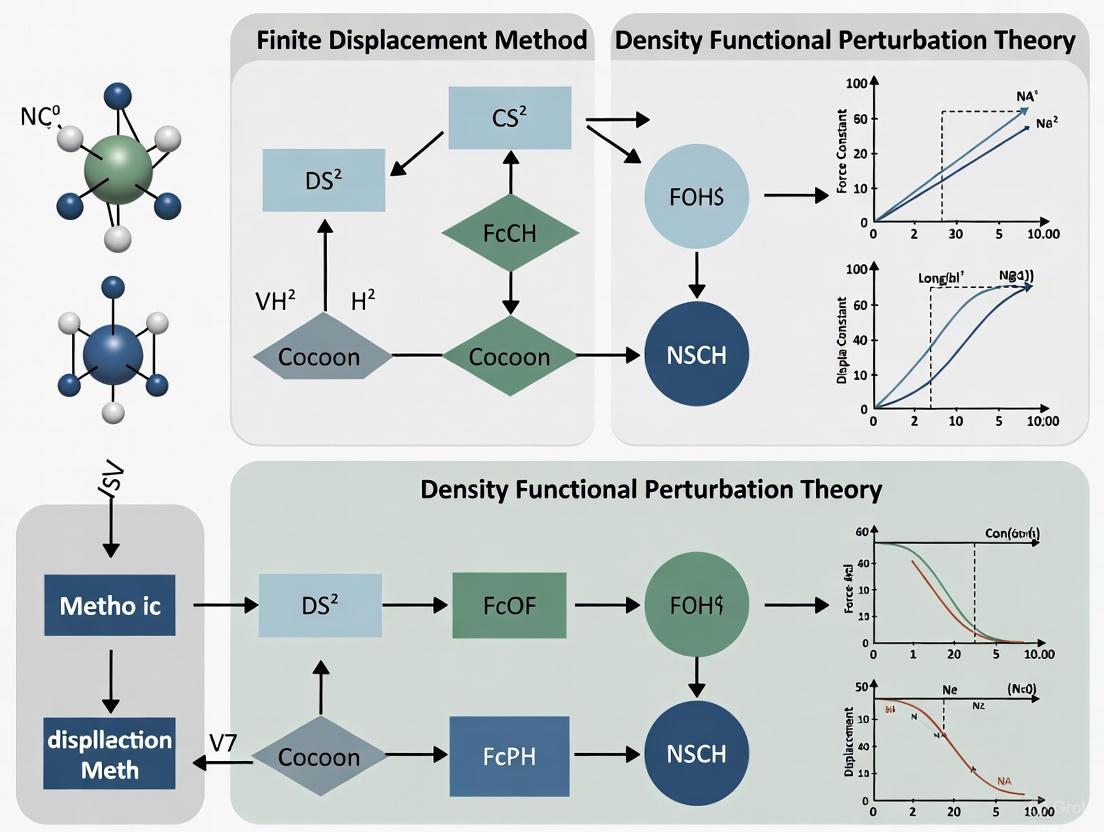
Finite Displacement vs. DFPT for Phonons: A Comprehensive Guide for Computational Materials Research
This article provides a detailed comparative analysis of the two predominant methods for calculating phonon properties in materials: the finite displacement (frozen phonon) method and density functional perturbation theory (DFPT).
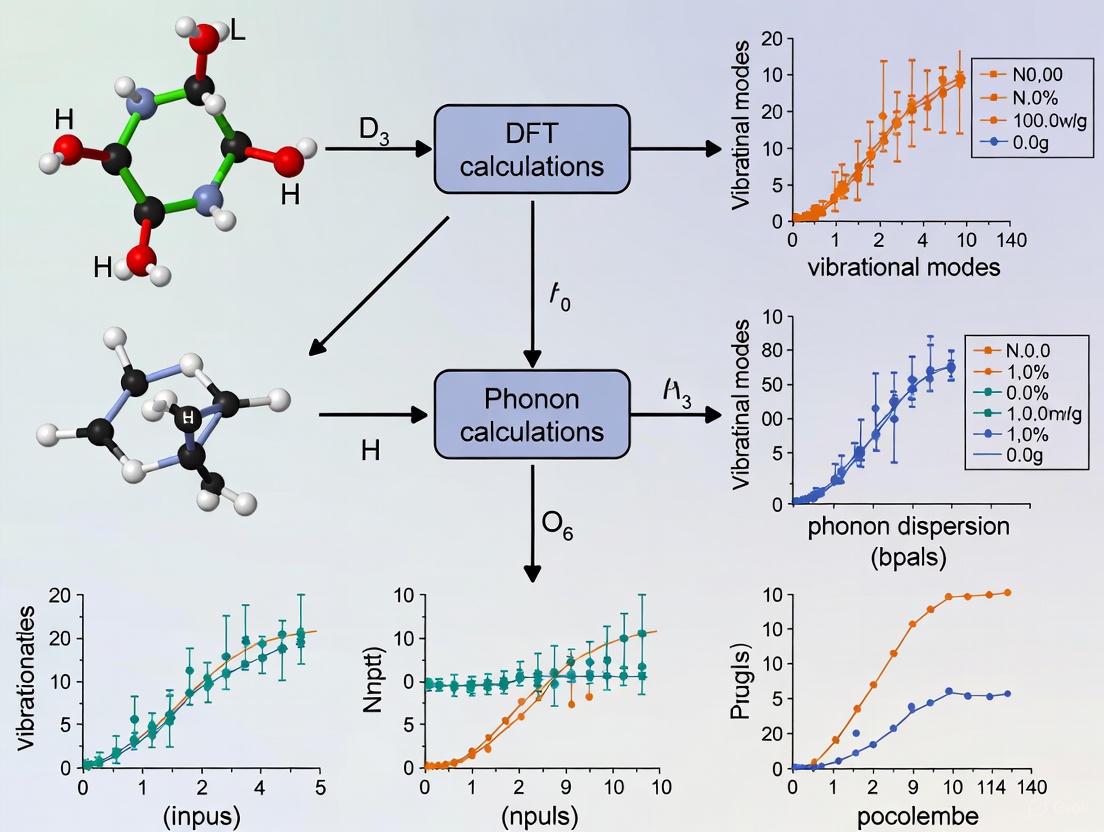
Handling Unstable Structures in DFT Phonon Calculations: A Comprehensive Protocol from Foundations to Validation
This article provides a comprehensive guide for researchers performing Density Functional Theory (DFT) phonon calculations on dynamically unstable structures.